ECON010 Lesson 02: More Definitions

As we continue our 30,000 feet overview of Economics and terms we have a couple sets of paired ideas to consider. With the idea of scope in mind, we use Macroeconomics to examine the economy as a whole. It is the big picture that encloses everyone and everything as a single chunk. Microeconomics looks at an individual entity and it’s interaction with the greater economy. It could be an individual, household, company, or governmental unit in view when we examine their decisions and the consequences of  the same.

Our analysis of actions and consequences can be viewed from different points of view. When we analyze actions with the mind-set that this is “how things SHOULD work” we are doing Normative Economics. Using the view of “this is how things ARE working” we refer to this as Positive Economics. These views are not necessarily the same, and one is not necessarily “better” than the other. Both types of analysis have their uses and each carries its own powers and pitfalls.

As it would be impractical (impossible, really) to interview every person or monitor every transaction in any realistic economy, we use a Model to simplify our work. It is a smaller or simpler representation of a system created to simplify analysis. It will keep the essential parts of a system and minimize (or ignore) unnecessary elements not being studied. A model is created (or designed) to build a framework in which to demonstrate and test a Theory, formally defined in my notes as “a simplified, logical story based on positive analysis that is used to explain an event.” (It should be noted that I found my teaching notes; I did NOT find my text book the notes came out of. I may refer to my copy of The Essentials of Macroeconomics I from Research and Education Association, ISBN 0-87891-700-4 for additional information and will identify anything thus sourced with the marker [REA].)

The method presented in class for creating and evaluating concepts was to use the Scientific Method, a five (5) step process:

  1. Recognize a problem or issue
  2. Make needed Assumptions (conditions accepted as true without justification or proof)
  3. Develop a model based on selected system and assumptions
  4. Present a Hypothesis (statement that explains a set of facts and action->consequence chains) to describe the analysis
  5. Test hypothesis for validity (whether the model and theory works or not)

To see how this works, we could setup an example. While working on my blog my pencil rolled off the table and fell to the floor (a couple of times, actually). Since nothing else has fallen off the table, I suspect gravity in my apartment has a special affinity for pencils (step 1: recognize issue). I will assume there are no other forces (wind, telekinetic psychics, or poltergeist spirits) at play here (step 2). I went into the kitchen and cleared the table to use as a model of my desk (step 3). My hypothesis is that pencils are more likely than other objects to fall to the floor (step 4). I then set a number of different objects on the table to see if they would roll off and fall to the floor:

\begin{array}{lc}  \textbf{Item} & \textbf {Fall?} \\  Pencil & Yes \\  Pen & No \\  Coffee Mug & No \\  Coffee (spilled) & Yes \\  Can (upright) & No \\  Can (horizonal) & Yes \\  Egg & Yes \\  Banana & No \\  Book & No \\  \end{array}
Since other objects than the pencil fell, I must accept that the hypothese is not valid (and now I have a real mess to clean up in the kitchen).

A couple of common mistakes in creating hypotheses to watch out for is the Fallacy of Causation (“since this implies because of this,” just because two things happened together one causes the other) and the Fallacy of Composition (“what one does all do,” or just because Bert puts ketchup on his ice cream, everyone does…or should). My example failed on the falacy of causation.

When we are dealing with models and analysis a critical concept we need to keep fully aware of is that of Ceteris Paribus (Latin for “all other things being equal”). It is used when we make a claim explaining an event (if price for a good goes up, demand will go down [CP]) so that the ONLY thing changing is the item being examined (price). The idea is to eliminate or ignore everything else that might have an effect on the transaction being examined. In a fully interactive system, rising prices might actually result in higher demand (in anticipation of a shortage, for example) but to explain principles we hold all other elements the same to focus our attention on how just one element works. We will use the code [CP] as an abbreviation.

This covers everything in the first meeting of my class, apart from a few drawings on the board. They included examples of several types of Graphs or Charts (line, bar, pie, scatter), the concept of Slope (how much the Dependent variable changes when the Independent variable changes and which direction), Maximum, and Minimum (on charts). The key parts are shown on the following picture.
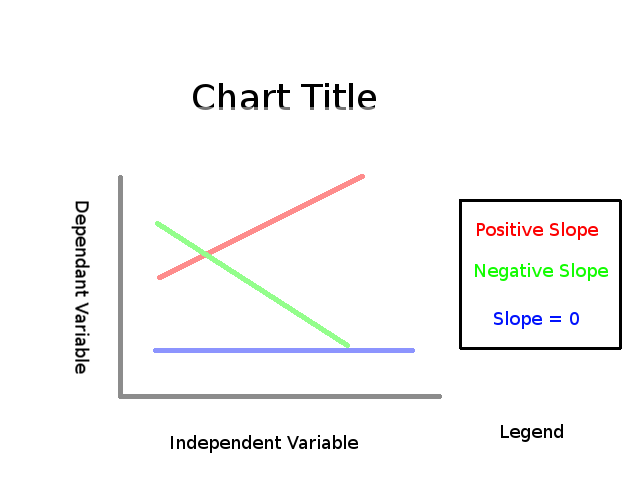
Chart Examples for Lesson 02

Chart Examples for Lesson 02

Next time we start on Choice, Opportunity Cost, and Specialization!

Phred

post 69 of n

Go to LESSON 01

Go to GLOSSARY

ECON010 Lesson 01: Introduction and Definitions

Welcome to Lesson 01. Today’s article gives an overview of the course and starts setting terms in order to create the playing field for understanding the subject.

Economics is the study of making choices about how to use limited resources. It arises from the idea that we are restricted from obtaining everything we want (where the “we” here is every entity at once; individual, family, clan, organization, city, state, country, whatever). The idea of Unlimited Wants (the sum total of the desires of everyone) is expressed in this Q&A:

Q: How much [Item Name Here] is enough?

A: Just a little more!

The bottom line is “wants are unlimited.”

The problem is described in the term Scarcity, the idea there is not enough [Item Name Here] to provide everyone all they want for the cost of free. Can also be expressed in a Q&A:

Q: How much of [Item Name Here] is there?

A: Not enough for both of us…

The principle reason is we live on a closed system. The Earth (in fact, the observable universe) has a limited amount of resources (might be a lot, but they pall in comparison to the infinite size of the unlimited size of wants). Douglas Adams demonstrated this in chapter 32 of his book The Restaurant At The End Of The Universe when the [useless survivors of a crashed spaceship] hold a meeting to discuss fiscal policy. They make money from leaves which makes them immensely rich, but then they “run into a small inflation problem on account of the high level of leaf availability, which means that, I gather, the current going rate has something like three deciduous forests buying one ship’s peanut.” The meeting decides to burn down the remaining forests (which will make the leaves they have already collected and stuffed into their clothes vastly more valuable), a short term (not to mention short sighted) solution to an insolvable problem.

As is common in many specialized fields, some words in common use have somewhat different meanings when used in an economic sense. Goods are defined as tangible things that can be exchanged (between people) that are also scarce. Again, there may be a lot of them, but if there is not enough for everyone that wants one to have one (for free) then it is scarce. People are willing to pay to obtain goods. Bads are items people are willing to pay NOT to have (or to have less of) such as pollution. Goods come in two types: Durable goods are things expected to last at least a year (cars, computers, refrigerators);  Non-durable goods are everything else with a shorter expected life (donuts, calendars, pretty much anything inside a refrigerator). Services consists of work done that doesn’t result in the production of a good. In general, it is goods and services that are used to fulfill the unlimited desires of everybody.

Resources are the tangible and intangible things used to obtain “stuff” to fulfill wants. In other words, the things we use to get everything else. (Stay with me, it can get kind of confusing in here.) Resources come in four flavors:

  1. Land – the Earth and natural resources like soil, timber, water, oil
  2. Labor – the time, physical, and intellectual services of people (brains and brawn); includes training, talent, education, ability
  3. Capital – created products used to produce other goods and services; ranges from factories to the machines inside to the screwdriver used to work on the machines…
  4. Entrepreneurial Ability – an intangible skill that allows a person to create  goods and services by
    1. recognizing a profitable opportunity
    2. willingness to organize the other three resources (land, labor, and capital), and
    3. willingness to take a risk

An Entrepreneur is a person with (4) that takes raw materials (1) and combines it with workers (2) and tools (3) to produce a good or service.

Rational (as in rational self interest) does not mean able to be expressed as a fraction or sane or sensible as we generally understand it. In economics people are assumed to make choices that maximize the amount of satisfaction they receive from that choice.

It does not necessarily mean they make a logical choice (to another observer) only that the decision results in the greatest level of satisfaction to the decision maker. To evaluate various competing elements of satisfaction (fame, fortune, physical pleasure) that have different units of exchange we discuss measures in terms of Utility. This is an arbitrary unit of measurement that allows us to compare two choices without the problems of comparing apples and kumquats. If choice A yields 7 units of utility and choice B only 5, the “rational” person will always choose A.

The idea of Margins deals with the very next (or last, depending on how it’s used) item under consideration. The utility of eating a donut changes if it is the first one you have had in a month or if it is the 17th one this hour. In either case (before the actual eating) the satisfaction you perceive from eating the NEXT pastry (number 1 in the first case or number 17 in the latter) would be considered the marginal value of the donut. As we go along, the importance of dealing with the margin will be explained.

The last term for this lesson to consider is Income. Income generates a method of exchange (for now, think “money” but be aware we will need to address exactly what this word means later on) as a result of the use of resources. Using land generates rent, using labor results in wages, interest comes from using capital, and profits are the result of entrepreneurial activity in action.

With this groundwork in place (about half of the first class lesson plan, not counting the materials from the chalkboard) we have started to lay the groundwork for understanding this slippery creature of economics. Next time we will continue to define terms and cover the concept of Ceteris Parabus, a critical point of view that will haunt us throughout our study.

Phred

post 66 of n

Introduction To Econ010: Economics For Normal People

I am not a very observant person (you need to smack me in the face 4-5 times with a dead mackerel before I realize you have a fish in your hand). I don’t really make a point of watching other people when I go anywhere but lately I’ve been listening to talk around me. The people discussing next week’s election proposals on taxes, millages, proposals, and other conversations on minimum wage and inflation, interest rates and the economy in general has led me to an obvious conclusion: the average [American] knows nothing about economics.

Long, long ago in a galaxy college far, far away, I graduated with a BBA in Accounting. The following year, the dean at the school decided I could help to repair the damage to universal karma by teaching a couple of courses as retribution. I agreed to the sentence and was assigned to teach Basic and Advanced Algebra (not unexpectedly, as I was the only tutor for Calculus in the college and had a couple of students travel 60-90 minutes each way to come to my tutorial sessions, along with the countless others assisted in all math classes locally). Then she announced (with a strange gleam in her eye) I needed another class to fill, and casually announced I would take the 10:00 AM slot in Macroeconomics.

I thought I would choke to death. My protests of inadequacy and that I had only just completed the course the year previously were brushed off without a thought. “You’ll do fine” she announced and it was settled. I would teach mornings Monday through Friday and have office hours from nine to noon on Saturdays. There were over sixty victims in the two algebra courses and only 2 fatalities in grading.

The Econ group consisted of just seven brave souls and a terrified teacher. The principle truth of the education process is that you don’t necessarily need to know MORE than your students, just that you need to learn FASTER than they do. Eventually we finished, all much wiser (and at least fractionally smarter) than when we started. I felt we had accomplished a great task, that there were at least eight people in my local area that understood more about how the world worked that when we started.

Recently I discovered my notes from that class and, with the above mentioned observations, I have decided to write a series of posts to help others get an overview of this topic. I will setup a table of contents page (not sure where it will be or what it will look like, but I’ll get it worked out for you) listing articles as they come out, including a glossary with terms used for review. All relewant postings will start with the title ECON010 (based on the numbering system of schools where 1xx classes are first year, 2xx are second and so forth…while 099 is normally used to do remedial classes like refresher English or Math, I think the current level of general knowledge requires a remedial class to take the remedial class…). The goal is to post an article a week to this topic (a new Category and Tag will be made just for these postings) and there is at least a dozen lessons to cover. I suspect some (many) [most] {all?} will need to take a couple of posts to cover the materials, so eventually it will probably go to several dozen posts altogether.

I expect the first will come next week, the first full week in May. Of course it will depend on the available alternative choices and ultimately where the greatest utility lies (teaser) but I hope to have at least a small input in the lives of several people over the next year. So that (perhaps) the next time I hear a discussion at the mall I might hear something other than pointless drivel spewing from the participants.

Then again, maybe I need to move further away from the cell phone sales area…

Phred

post 56 of n